
Let’s be honest — cracks in drywall are annoying. They show up out of nowhere. They make your home look older than it actually is. And if you live in the USA, especially around Princeton, NJ, you’ve probably dealt with them at least once. According to the U.S. Census Housing Survey, over 75% of American homes deal with drywall cracks every 5 years. And if you’ve already searched for drywall repair in Princeton, you’re definitely not alone.
Here’s the thing no one really says:
Some cracks are harmless. Others are red flags. And some cracks keep coming back no matter how many times you fix them. So let’s break this down without the fluff.
What Really Causes Cracks in Drywall (The Honest Version)
Yes, there are “official” reasons. But here’s the real-world explanation — the version homeowners relate to.
Drywall cracks because your house moves.
It shifts. It expands. It dries out. It absorbs moisture. It reacts to temperature the way our skin reacts to winter — badly.
Let’s go through the causes, but in a way that actually makes sense.
1. Your House Settles — And That’s Normal
Every home settles. Even brand-new ones.
You’ll often see cracks:
above door frames
at window corners
where walls meet ceilings
Think of your house like a giant treehouse on dirt. The soil compresses. The wood adjusts. Everything shifts a bit. Drywall doesn’t like movement, so it cracks. Nothing mysterious — and usually nothing serious.
What usually works:
Reinforcing the crack with proper tape and compound.
What usually fails:
Quick squeeze-tube “patch repair” kits. They hide the crack for a month, then it returns like a bad sequel.
2. Humidity in Princeton Works Against You
Princeton has humid summers and dry winters. This alone is enough to torture your drywall.
Humidity makes materials expand. Dryness makes them shrink.
So walls move.
Just a little… but enough.
Signs humidity is the villain:
cracks appear every summer
paint bubbles
tape starts peeling
And trust me — no amount of patching works if humidity keeps swinging wildly.
What helps:
A dehumidifier in summer. A humidifier in winter. It’s simple but truly makes a difference.
3. The Drywall Was Installed Too Fast (or Wrong)
Here’s a true opinion: 90% of recurring cracks come from bad installation.
Bad taping → recurring cracks.
Too little joint compound → recurring cracks.
Cheap materials → recurring cracks.
Drywall is one of those things where rushing the job never pays off. A wall can look perfect today and crack next season.
You’ll see this a lot in:
flipped homes
older homes "updated" quickly
DIY projects gone wrong
What fails:
One thick layer of mud. It always shrinks and cracks again.
What works:
Multiple thin layers, drying fully between each. The boring way — but the right way.
4. Foundation Movement (This One Deserves Attention)
If your cracks look jagged or diagonal, stop ignoring them.
Possible signs your foundation is shifting:
doors suddenly stick
floors feel uneven
long cracks from window corners
cracks wider than 1/8 inch
Is it always serious? No.
Can it be? Absolutely.
Here’s my personal judgment:
If a crack makes you tilt your head and say, “Hmm that doesn’t look right,” call someone.
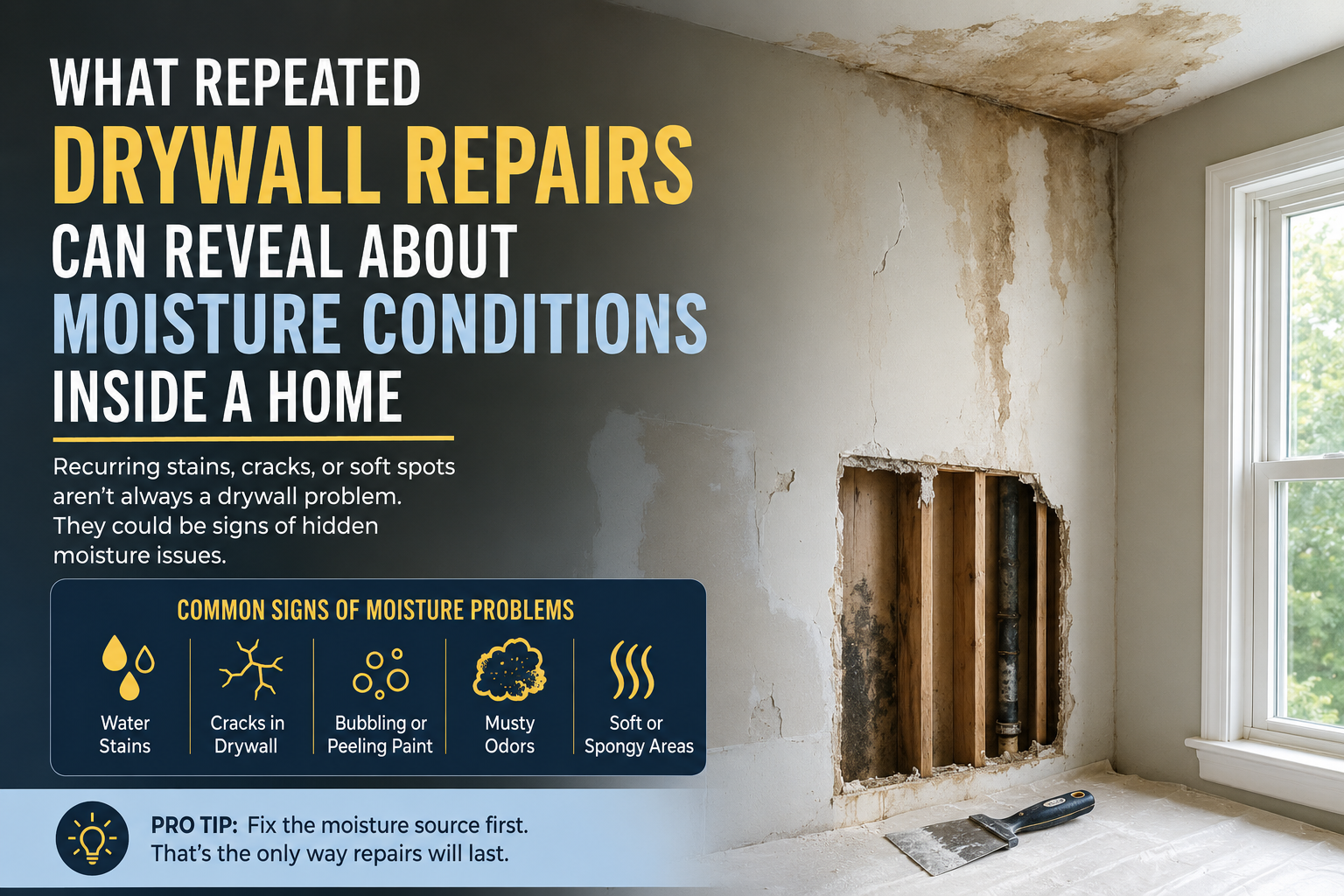
5. Water Damage Behind the Wall
This one’s sneaky.
Water can:
weaken drywall
dissolve joint compound
bubble paint
create yellow stains
If you spot discoloration with a crack, don’t patch it. You’re basically putting makeup on a wound.
Fix the leak → then fix the drywall.
6. Everyday Vibration (Yes, Really)
It sounds silly, but vibrations matter.
slamming doors
kids jumping upstairs
nearby roadwork
mounting a heavy TV
Little vibrations add up over months or years.
Drywall does not like being shaken.
At all.
How Serious Is the Crack? A Quick Table (No Overthinking Needed)

A simple rule:
If it widens over time, don’t wait.
How Professionals Repair Drywall Cracks (The Honest Process)
I’ve seen people spend hours watching DIY videos, then wonder why their repair looks like a lumpy pancake. Drywall is easier than it looks — and harder than you think.
Here’s the real process most pros follow, including the crew at Mr. Handyman of Princeton.
Step 1: Find the Real Cause Before Fixing Anything
A good repair starts with figuring out why the crack formed.
A pro checks:
moisture
framing movement
tape failure
wrong type of compound
installation shortcuts
Patching without diagnosis is like putting duct tape on a leaky boat.
Step 2: Cut the Crack Open (Yes, Really)
This surprises a lot of homeowners.
We actually widen the crack slightly. Not to make it worse — but to make room for fresh compound to bond deep inside.
What fails:
Smearing compound over the surface.
What works:
Opening the crack → filling it properly → reinforcing it.
Step 3: Add Reinforcement Tape
There are two types:
Paper tape → best for long-term strength
Mesh tape → easy to apply but not always the strongest
Real opinion:
Paper tape lasts longer. Mesh tape is easier but more prone to cracking again if the wall moves.
Professionals choose based on the crack type.
Step 4: Apply Multiple Thin Layers of Joint Compound
Thin layers dry better and reduce shrinkage. Thick layers are the #1 DIY mistake.
A pro usually applies:
First fill layer
Second feather layer
Third smoothing layer
Each one gets wider and smoother.
Step 5: Sanding (Where Patience Matters)
Good sanding makes the repair look invisible.
Bad sanding looks like a dent or a bump.
Pros use fine-grit paper and bright lights to see imperfections.
Step 6: Prime and Paint
Primer is not optional. If you skip it, the patched area will flash — meaning it looks different under the paint.
This is the last step that makes everything look like nothing ever happened.
Real Questions People Actually Ask
Why do cracks keep coming back?
Because the cause wasn’t fixed. Patching alone doesn’t solve movement or humidity.
Are small cracks normal?
Yes. Homes move. Drywall cracks. It’s like wrinkles — part of life.
Should I worry about cracks near doors?
Only if they’re diagonal or growing.
Will painting over cracks work?
No. You’re just covering the problem. It’ll come back.
When should I replace drywall instead of repairing it?
If it’s wet, moldy, crumbling, or cracking everywhere.
DIY vs Professional Repair: A Quick, Honest Comparison

My opinion:
DIY is great for tiny hairline cracks. Anything bigger becomes a headache.
A Real Princeton, NJ Example (Because Real Stories Help)
A homeowner in Princeton kept patching the same crack above their dining room doorway. Three times. Each time, the crack returned like clockwork.
When Mr. Handyman of Princeton checked it, the issue was simple:
The original drywall installer didn’t use tape at that seam.
No tape = guaranteed crack.
We:
reopened the seam
added paper tape
applied 3 layers of compound
sanded and repainted
End result?
The crack hasn’t returned — because the real issue was finally fixed.
How to Prevent Drywall Cracks (Simple, Not Complicated)
Here’s what actually works:
1. Keep indoor humidity around 40–50%.
This alone prevents so many cracks.
2. Avoid slamming doors.
Yes, it really matters.
3. Fix leaks early.
Moisture and drywall are enemies.
4. Watch seasonal cracks.
If they grow, don’t ignore them.
5. Hire a pro for cracks that keep returning.
A recurring crack is telling you something.
Why Hire Mr. Handyman of Princeton? (The Straight-Up Reason)
They don’t just hide cracks — they stop them from coming back.
You get:
honest diagnosis
skilled workmanship
clean finishing
proper reinforcement
long-lasting results
And they’re local to Princeton, NJ, so they actually understand the humidity swings, older home structures, and common settling issues in the area.
Final Thoughts: Cracks in Drywall Aren’t the Enemy — Ignoring Them Is
Here’s the truth: Drywall cracks happen. Almost every home gets them at some point. Most cracks are harmless, some are warning signs, and all of them can be fixed the right way if you don’t ignore what caused them in the first place.
If there’s one thing I’ve seen over and over, it’s this:
A crack that keeps coming back is telling you something — and it won’t stop until that “something” is fixed correctly.
That’s why working with a pro matters.
And if you’re in or around Princeton, NJ, this is exactly where Mr. Handyman of Princeton makes a real difference. They don’t just cover cracks; they repair the root issue, reinforce the wall properly, and leave the surface looking clean and smooth again.
So if you want that crack gone — and gone for good — Mr. Handyman of Princeton is the team that gets it right the first time.
Read More Blog:
The Complete 2025 Home Repair & Maintenance Guide for Princeton Homeowners



Write a comment ...